`
*(Recommended remains stable even if your IP changes, e.g., after migration.)*
3. Verify DNS propagation using a tool like: [https://dnschecker.org/](https://dnschecker.org/)
Once propagation is complete, the SSL certificate will be **automatically generated and renewed**, and HTTPS will start working.
---
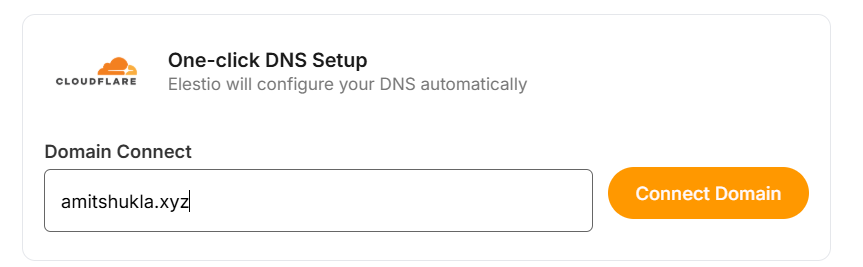
##### **Method 2: One-Click DNS Setup via Cloudflare (Domain Connect)**
A **One-click DNS Setup** section is available if the domain name server or registrar is Cloudflare, allowing automatic DNS configuration via the Domain Connect protocol.
[](https://docs.elest.io/uploads/images/gallery/2026-04/q54image.png)
##### Steps
1. Enter your domain (e.g. `example.com`).
2. Click **Connect Domain**.
3. This action will redirect you to the Cloudflare dashboard for accepting the DNS record configuration.
---
##### **Cloudflare Reverse Proxy Users**
If you are using method 1 and want Cloudflare with the proxy enabled (orange cloud icon), refer to the detailed guide:
[https://docs.elest.io/books/security/page/using-cloudflare](https://docs.elest.io/books/security/page/using-cloudflare)
---
##### **Environment Variable Update**
Some applications require updating an environment variable to reflect the configured domain.
To update:
1. Go to the **Overview** page of your pipeline.
2. Click the **Build & Deploy** tab.
3. Open the **Environment variable** section.
4. Update the domain-related environment variable.
---
##### **Troubleshooting: SSL Not Generated**
**View Nginx Logs**
You can inspect logs using a terminal command:
```
cd /opt/elestio/nginx;
docker-compose logs -f;
```
Press `Ctrl + C` to stop live log output.
---
##### **Reset SSL Data Folder**
In some cases, the SSL data directory **/opt/elestio/nginx/ssl\_data** may become corrupted:
To fix:
1. Connect to your service via terminal.
2. Run the command below.
```
cd /opt/elestio/nginx/;
docker-compose down;
mv ./ssl_data/ ./ssl_data_old/;
mkdir ./ssl_data/;
chmod 777 ./ssl_data/;
docker-compose up -d
```
Once executed, just open your custom website URL again; your certificate should be generated, and your site served over SSL/TLS.
We recommend using CNAME records instead of A records; that way, if you later decide to move your pipeline in 1 click from our UI, it will work right away. If you used an A record, you will have to go back to your registrar to update the A record to point to the new IP address.