# Connecting with PHP
This guide explains how to connect a PHP application to a Hydra database using the **PDO extension**. It covers setting up prerequisites, configuring the connection URI, and running a test SQL query.
### **Variables**
To connect to a Hydra database, you only need **one environment variable** — the connection URI.
**Variable**
**Description**
**Purpose**
`HYDRA_URI`
Full Hydra connection string from Elestio
Encodes all connection info in one URI
A typical URI looks like this:
```
postgresql://:@:/
```
You can find the details needed in the URI from the **Elestio service overview** details. Copy and replace the variables carefully in the URI example provided above.
[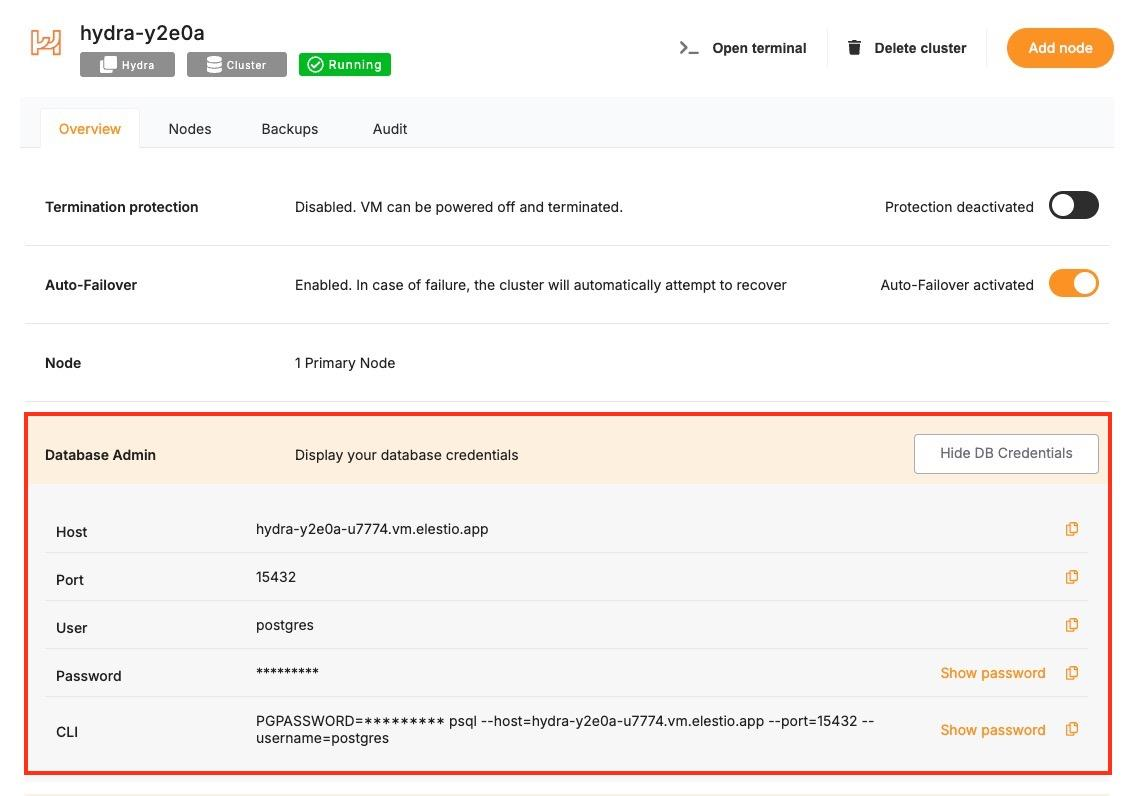](https://docs.elest.io/uploads/images/gallery/2025-05/eTcimage.png)
### **Prerequisites**
**Install PHP**
Check if PHP is installed:
```
php -v
```
If not, download and install PHP from: [https://www.php.net/downloads.php](https://www.php.net/downloads.php)
### **Code**
Once all prerequisites are set up, create a new file named `hydra.php` and add the following code and replace the `HYDRA_URI` with actual link or in environment setup as you wish:
```php
query("SELECT VERSION()")->fetchColumn();
echo "Connected to Hydra: " . $version . PHP_EOL;
} catch (PDOException $e) {
echo "Connection failed: " . $e->getMessage() . PHP_EOL;
}
```
To execute the script, open the terminal or command prompt and navigate to the directory where `hydra.php`. Once in the correct directory, run the script with the command
```bash
export HYDRA_URI=postgresql://user:password@host:port/database
```
Navigate to the directory containing `hydra.php` and run:
```
php hydra.php
```
If successful, you’ll see output like:
```
Connected to Hydra: PostgreSQL 14.13 (Debian 14.13-1.pgdg120+1) on x86_64-pc-linux-gnu, compiled by gcc (Debian 12.2.0-14) 12.2.0, 64-bit
```